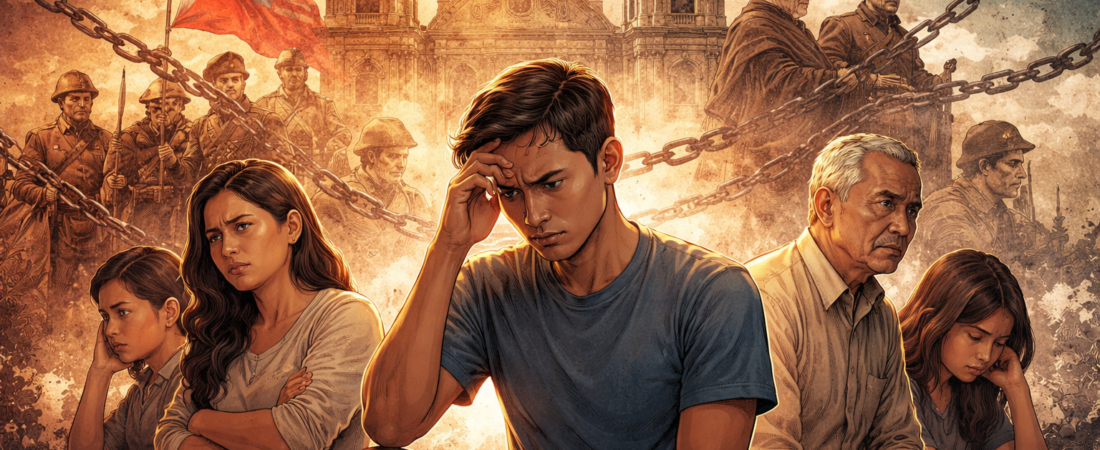
The phrase “toxic Filipino traits” appears frequently in online searches and discussions, especially among Filipinos and Filipino-Americans trying to make sense of recurring social and family dynamics. The term is emotionally charged, but it points to something real: patterns of behavior that cause relational strain, particularly around criticism, boundaries, and conflict.
What’s often missing from these conversations is context. These traits did not appear randomly, nor are they evidence of inherent flaws. They are best understood as trauma-adapted behaviors shaped by colonization, hierarchy, and shame-based social regulation, later intensified by modern media and algorithmic incentives.
Understanding this distinction matters. Without it, “toxic traits” become another layer of shame—reinforcing the very behaviors people want to change.
What People Commonly Mean by “Toxic Filipino Traits”
Across forums, diaspora discussions, and intergenerational conversations, the same patterns tend to surface:
- Extreme sensitivity to criticism
- Silent treatment (tampo) instead of direct discussion
- Indirect or avoidant communication
- Weak personal boundaries, especially with elders
- Guilt-based family control
- Gossip, public shaming, or online dogpiling
- Pride mixed with insecurity and defensiveness
These are not universal behaviors, nor are they unique to Filipinos. But they do appear with enough consistency to suggest a shared underlying mechanism.
Trauma Responses, Not Personality Defects
From a psychological standpoint, many of these behaviors map cleanly onto trauma responses:
- Fight: defensiveness, emotional escalation, public shaming
- Freeze: withdrawal, silence, avoidance
- Fawn: people-pleasing, appeasement, self-erasure
In environments where direct confrontation historically carried social or physical risk, these responses were adaptive. Over time, they became normalized as “culture.”
What complicates matters is that these trauma responses often resemble narcissistic traits—but not in the clinical sense most people imagine.
Narcissism as a Defense, Not a Diagnosis
In psychology, narcissism isn’t only a personality disorder. It can also describe defensive ego strategies used to regulate shame, insecurity, and powerlessness.
In colonized or highly hierarchical societies, narcissistic defenses often look like:
- Fragile self-esteem masked by pride
- Intolerance of criticism
- Image management over accountability
- Collective identity used as ego armor
This form of narcissism is reactive, not dominant. It doesn’t emerge from entitlement and excess, but from long-term disempowerment.
Colonial Roots of the Pattern
1. Shame as Social Control
Under Spanish colonial rule, Catholic morality and public shame were primary tools of governance. Obedience, humility, and endurance were framed as virtues; confrontation and dissent were framed as moral failures.
The legacy of hiya (shame) still shapes how feedback is processed. Criticism doesn’t land as information—it lands as humiliation. Emotional defensiveness becomes self-protection.
2. Hierarchy Without Accountability
Colonial and post-colonial power structures reinforced rigid hierarchies: church over people, elites over masses, elders over youth. Authority was not expected to explain itself.
In such systems, boundaries flowed one way. Elders and superiors could demand obedience; subordinates learned silence. Today, this shows up in families where respect is expected, but accountability is absent.
3. Survival-Based Collectivism
Collectivism in the Philippines was shaped less by abundance than by scarcity and external threat. Group harmony became essential for survival.
The downside is that individual dissent is easily perceived as betrayal. When identity is fused with family, culture, or nation, criticism feels existential. Defensive reactions—especially online—become predictable.
4. Emotional Expression Without Repair
In many Filipino environments, emotional expression is permitted, even encouraged. What is not modeled is repair: calm discussion, boundary negotiation, resolution.
Historically, emotion was safer than agency. Venting carried less risk than confronting power. The result is a culture where feelings are expressed freely, but conflicts linger unresolved.
How This Manifests Today
Sensitivity to Criticism
Often mislabeled as immaturity, this reflects shame intolerance. When self-worth is externally regulated, criticism threatens identity.
Silent Treatment (Tampo)
A freeze response disguised as emotional signaling. Silence becomes leverage when direct communication feels unsafe.
Weak Boundaries
Especially in families, saying “no” is moralized as selfish. Self-erasure is reframed as love or respect.
Gossip and Dogpiling
Aggression that cannot move upward is redirected laterally. Social media amplifies this tendency by rewarding outrage and moral posturing.
Pride–Insecurity Oscillation
A hallmark of trauma-based narcissistic defense: seeking validation while rejecting critique. Praise feels safe; nuance feels dangerous.
Why It’s Worse Online Than Offline
Offline Filipino culture is often described as warm, hospitable, and generous. Online spaces distort this because:
- Algorithms reward emotional extremes
- Identity-based reactions spread faster than nuance
- Loud minorities dominate visibility
What looks like a national character flaw is often a platform effect layered onto historical wiring.
When These Patterns Become Harmful
These behaviors cross into harm when they:
- Block honest communication
- Normalize emotional manipulation
- Enable elder entitlement or abuse
- Prevent accountability and repair
- Trap families in cycles of guilt and resentment
This is why discussions about elder abuse, burnout, and estrangement increasingly intersect with trauma-informed perspectives in Filipino communities.
Evidence These Traits Are Not Fixed
One of the strongest arguments against biological or cultural determinism is how quickly these patterns change in different environments:
- Diaspora Filipinos exposed to direct-communication norms adapt rapidly
- Low-hierarchy workplaces reduce sensitivity and avoidance
- Trauma-informed families show stronger boundaries and repair
This proves the behaviors are context-dependent and reversible.
From “Toxic Traits” to Conscious Unlearning
Many Filipinos today are actively unlearning these patterns through:
- Emotional literacy and regulation skills
- Boundary education reframed as mutual respect
- Direct but non-hostile communication
- Reduced exposure to drama-driven media
- Trauma-informed therapy and ancestral healing work
This process doesn’t erase Filipino identity. It liberates it from survival modes that no longer serve.
A More Accurate Reframe
What’s often labeled as “toxic Filipino traits” is better understood as:
Collective trauma responses reinforced by colonial hierarchy, shame-based regulation, and modern amplification—mistaken for personality or culture.
Seen this way, the path forward is not shame or rejection of identity, but repair, boundaries, and conscious re-patterning.
Cultures evolve. So do the people inside them.